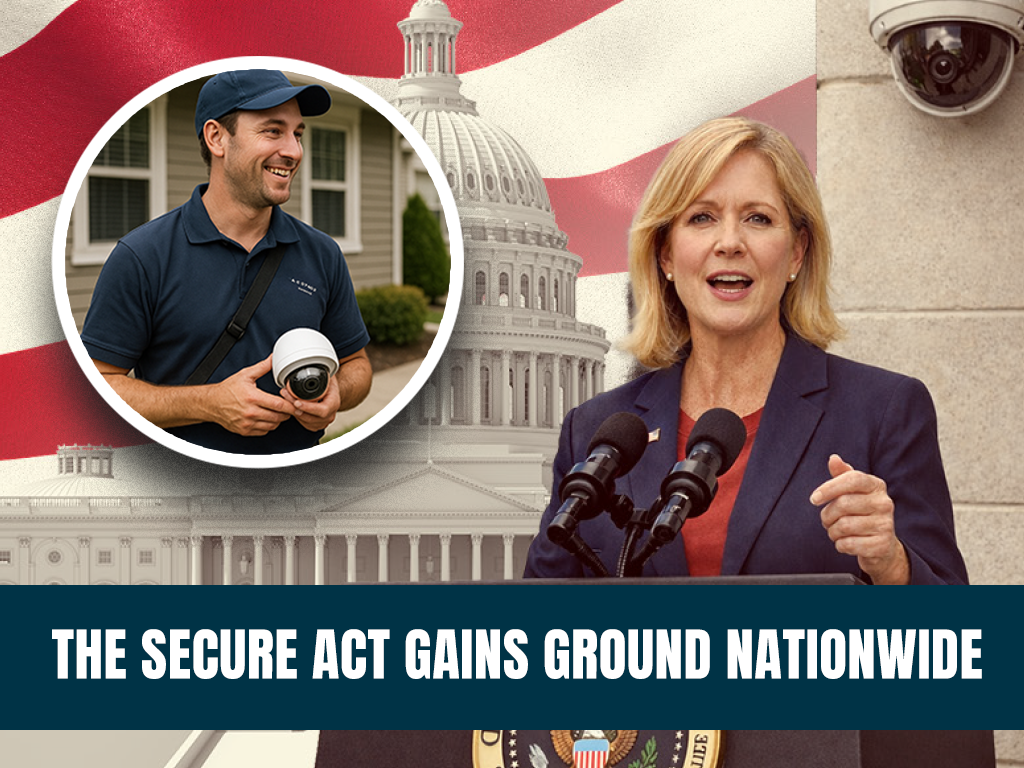
The SECURE Act Gains Ground Nationwide
By Taylor Criddle, VP of Advocacy and Public Affairs at ESA
Momentum is accelerating behind the SECURE Act, a common-sense policy solution designed to clarify that candidates and elected officials can use campaign funds for legitimate security expenses.
Over the past year, this initiative has expanded rapidly, with 19 states now introducing and actively pursuing legislation modeled on the SECURE Act. This growth reflects increasing recognition among policymakers that the threat environment facing public officials has evolved, while campaign finance rules in many states have not kept pace with modern security realities.
From Proposal to Law
To date, four states: Alabama, Illinois, Nevada, and Utah, have enacted the SECURE Act into law, which provides clear guidance allowing campaign funds to be used for security measures such as alarm systems, cameras, access control, and related protective services. These laws strike an important balance by establishing reasonable guardrails while ensuring that candidates and officeholders can take necessary steps to protect themselves, their families, and their staff.
Oregon is also on the verge of joining this group, with legislation currently awaiting the Governor’s signature. If signed into law, Oregon would become the fifth state to formally adopt this framework and further solidify the SECURE Act as a national policy trend.
Bringing Clarity to an Evolving Risk Environment
At its core, the SECURE Act is about transparency, consistency, and public safety. In many states, candidates are left navigating vague or outdated campaign finance rules that do not explicitly address modern security needs. This uncertainty can create hesitation around implementing essential safety measures, even as threats against public officials continue to rise. The SECURE Act addresses this gap by clearly defining allowable expenditures while maintaining accountability and appropriate limitations.
What It Means for the Security Industry
For the electronic security and life safety industry, this effort represents more than a policy clarification. It reinforces the critical role that professionally installed and monitored security systems play in protecting individuals and communities. By explicitly recognizing these systems as legitimate and necessary expenses, states are validating the importance of proactive security measures and creating new opportunities for integrators to deliver high-value solutions.
Collaboration Driving Adoption
The rapid expansion of the SECURE Act is being driven by collaboration between industry stakeholders, policymakers, and public safety advocates. Legislators across the country are engaging on this issue in a bipartisan manner, recognizing that personal safety should not be a partisan concern. This alignment has helped move the SECURE Act from concept to enacted policy in a relatively short period of time.
Looking ahead, the focus remains on advancing legislation in additional states and building on the success seen so far. With nearly twenty states already engaged, four states having enacted laws, and Oregon poised to follow, the SECURE Act is quickly emerging as a national model for addressing a critical and evolving public safety need.
As this momentum continues, the objective remains clear: ensure that those who step forward to serve their communities are not left vulnerable due to outdated or unclear rules, and that they have the ability to invest in reasonable, effective security measures that protect both themselves and the public they serve.