
Beyond the Alarm: Why Environmental Sensor Monitoring Is Becoming Table Stakes for Security Integrators
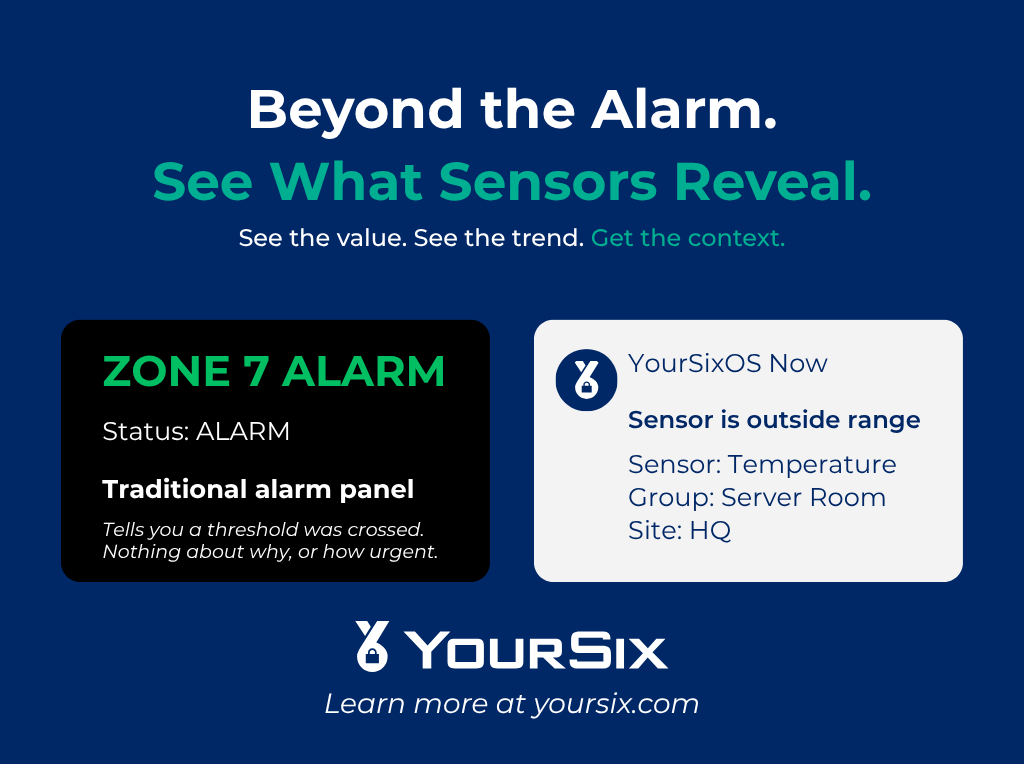
For decades, alarm monitoring has run on a simple logic: normal, alarm, or trouble. An operator sees “Zone 7 Alarm” and reacts. It works, but it’s also the limit of what most panels can tell you. There’s no context, no trend, no sense of whether a condition is getting better, worse, or was a one-off blip.
That gap is becoming a bigger deal for integrators. Customers aren’t just asking “will I know if something happens?” anymore. They’re asking what else the system can tell them about their space. Temperature swings in a server room. Humidity creeping up in a storage facility. Pressure or power fluctuations in a cold chain. These aren’t traditional intrusion events, but they’re exactly the kind of thing a facilities manager, property owner, or ops director wants visibility into, and increasingly expects their security provider to deliver.
The Difference Sensor Monitoring Makes
“Zone 7 Alarm” versus “47°F, up 9°F in the last 40 minutes.” Same event, very different amount of information.
- Traditional alarm: “Zone 7 Alarm”
- Sensor-based monitoring: “47°F, up 9°F in the last 40 minutes”
The second version doesn’t just flag a threshold crossing, it tells the story of what’s happening. Pull video from the same window and you’re not reacting to a trigger, you’re verifying a condition before you dispatch or escalate.
That’s the shift: from reactive alarm response to informed, verified decision-making.
Why Environmental Monitoring Matters for Your Business, Not Just Your Customer’s
This isn’t just a feature to mention in a proposal. It’s a natural expansion into accounts you already have:
- Recurring revenue without a new sales motion. Temperature, humidity, pressure, power, fluid levels, air quality: monitoring beyond intrusion and fire, sold into relationships you’ve already built.
- Harder accounts to lose. A customer using your platform to monitor conditions across their business, not just their doors, has more reasons to stay.
- A stronger story in competitive bids. Most RFPs get “you’ll be alerted.” Fewer get “you’ll be alerted, see the trend, and have video context before you act.”
Bringing Sensor Data Into the Broader Security Stack
The real value shows up when sensor data isn’t siloed. A sensor condition can trigger the same alarm rules, video verification, access control, audio, and professional monitoring workflows as any other event: one unified system instead of a patchwork of standalone tools.
It also means sensors don’t operate in isolation from the rest of the site. A temperature spike in a server room can pull in the nearest camera, the door access log, and a nearby speaker for talk-down, giving operators the full picture of what’s happening around the event, not just the reading itself. That’s one platform for you to sell, install, and support instead of three or four.
That’s the model behind Y6OS Sensors: real-time values and historical trends, tied to video and other connected devices, so operators (and your customers) get the full picture, not just a threshold croshttp://YourSixOS Sensorssing.
Learn more: YourSixOS Sensors