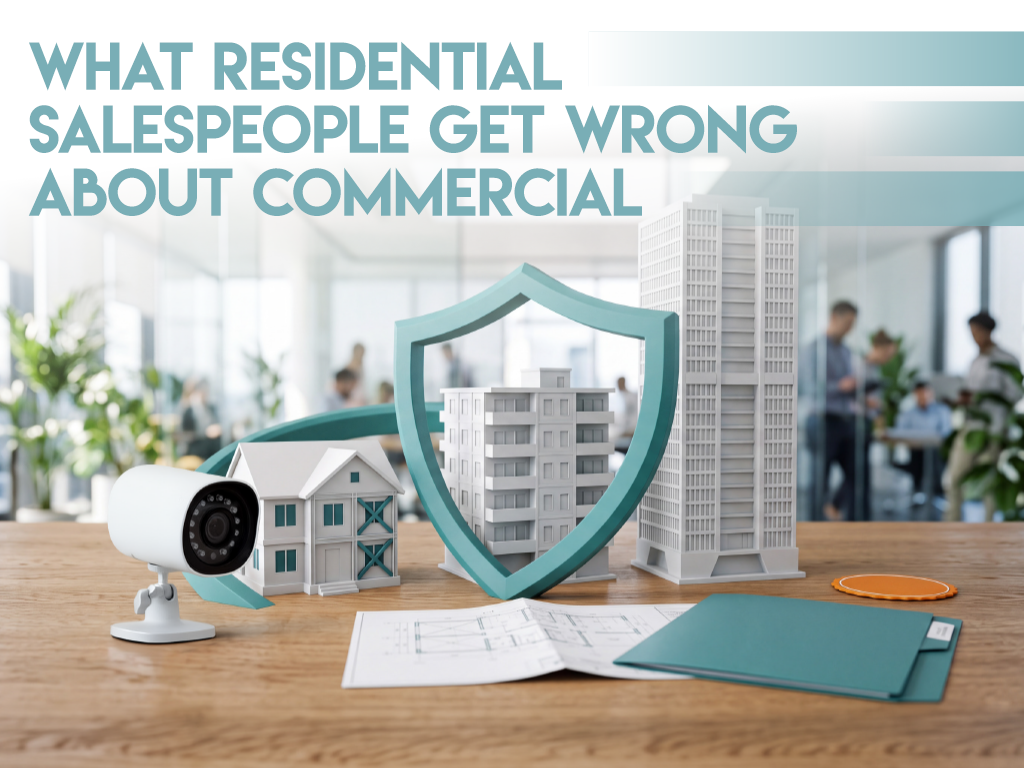
What Residential Salespeople Get Wrong About Commercial
By Chris Peterson, Owner and President, Vector Firm
Every alarm dealer company has at least one salesperson who can walk into a homeowner’s kitchen, build rapport in ten minutes, handle objections, and walk out with a signed agreement before dinner.
Now put that same salesperson in front of a facilities director, an IT manager, and a CFO who all need to sign off on a multi-building access control rollout. Watch what happens.
Most of the time, nothing happens except frustration experienced by the salesperson and the company.
The sales approach that builds your residential business is holding back your commercial business.
Traditional residential selling rewards speed. One decision-maker, one visit, one emotional trigger, and a close that happens in the same conversation. Over decades, alarm dealers built entire sales organizations around salespeople who are exceptional at doing exactly that. These types of salespeople have amazing skills that are often transferable to the commercial space, if they appreciate the difference.
An analogy I love is when former high school baseball or softball players join recreational slow-pitch softball leagues. They think: “This is nothing. The ball is bigger and it comes at me at half the speed – I don’t need to practice.” You know the end of that story. However, once the former high school stars appreciate the differences and adjust their swings, they kill it.
Shifting from residential to commercial sales is similar. Tenacity, curiosity, asking hard questions, and having a disarming personality are skills that make excellent commercial salespeople. However, not adjusting their approach will destroy most successful residential salespeople when trying to break into commercial markets.
What Commercial Sales Require
Commercial security selling looks a lot more like enterprise B2B sales than it does like the door-to-door model on which most alarm dealers grew. Commercial markets require the following things that contrast with the residential requirements.
1. Strategic plan: Commercial salespeople must lay out a plan for the markets they will pursue, common problems experienced by those markets, specific targets to pursue, and partnerships that will elevate their presence.
2. Patience with the process: Commercial salespeople need to stay engaged with the same targets and opportunities for months to years. Success requires patience and an organized system of tracking and follow-up that will keep hundreds of open tasks from being forgotten.
3. Technical fluency: Access control, video surveillance, and network infrastructure are topics that must be fundamentally understood. More important is understanding the personas and industries of the customers. Knowing the common problems faced by an IT Director for a hospital is just as important as understanding the specs of a camera.
4. Consultative and professional presence: Commercial salespeople work with decision-making committees ranging from two business owners to nine-person committees of executives of a publicly traded company. They must have competence, but they also must have the presence to deliver consultation in a way that is appreciated by these decision-makers.

Actions
Below are four things that must be done immediately to successfully grow a commercial business.
1. Make sure you have the right people selling to commercial markets: Like the slow pitch softball analogy, many will be able to transfer their skills, but some won’t. Look for salespeople who already ask more questions than they answer, who don’t panic when a prospect goes quiet for two weeks, and who are curious technical people who grasp the advanced knowledge needed for commercial markets. Many times, your best residential salespeople don’t make the cut – that’s OK.
2. Hire specifically for commercial: If you’re serious about growing your commercial business, at some point you need someone who has already sold into security, IT, and executive stakeholders, even if it’s from outside the security industry. B2B sales experience in adjacent trades like commercial HVAC, pro AV, or managed IT services often transfer well.
3. Radically change the compensation plan: The desired behaviors and expectations of future hires are completely different for residential sales and commercial sales. Do not try to use the same compensation plan or try to move your residential plan into a commercial one. Start over and get help from someone who has done this before.
4. Separate the teams entirely: The dealers scaling fastest into commercial aren’t asking their residential team to do both. They’re building a distinct commercial sales function. During the scaling period, there can be one leader of both teams, but it’s critically important that there is someone on the team with experience in successful commercial sales.
This Is Hard.
Moving into the commercial space will require hard work and harder decisions by leadership. However, it is possible. In short, don’t think the residential process or any components of it can evolve into commercial success, but some residential salespeople can successfully drive a new process, if they appreciate the difference.